Radio Free Quasar
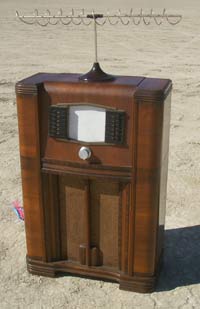
For Burning Man 2004, my project was an antique radio which receives emissions from nearby quasars (quasi-stellar radio sources). A computer inside generates the radio station sounds using a Python script which controls a chain of VST plugins for audio processing.
In addition to being heard, the sounds directly control the wild gyrations of a laser display, reflected onto the glass of the radio dial. Visitors tuned into a near-infinite selection of radio stations by turning a large silver knob.
What did it sound like?
Rick Ehrhart and I put together a little mini-CD with a few tracks of audio from Radio Free Quasar.
Audio Tracks
How was it built?
- Obtain antique radio from eBay.
- Install audio-controlled laser display. Add a mirror to reflect the beams onto the radio dial.
- Replace the radio dial with a sheet of paper, so the laser beams are visible.
- Install fanless low-power computer, with a DC-DC power supply so that it can be powered from a 12 volt battery.
- Add deep-cycle 12V battery, with a power sequencer to help turn the computer on and off reliably.
- Install speakers (USB-powered, i.e. low power).
- Install big silver knob (USB interface).
- Obtain funky antenna from eBay.
- Wrap antenna with EL wire.
- Write Python software that takes WAV files and processes them randomly with VST plugins.
- Add a back cover to the radio so it stands some chance against the elements.
Photos
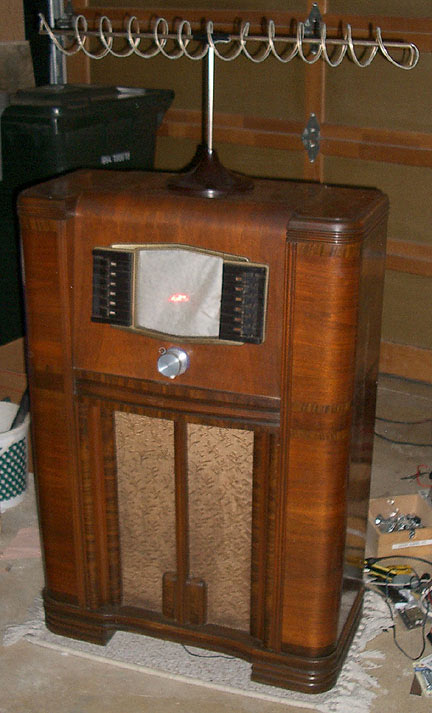
In daylight. This is what Radio Free Quasar looks like during the day.
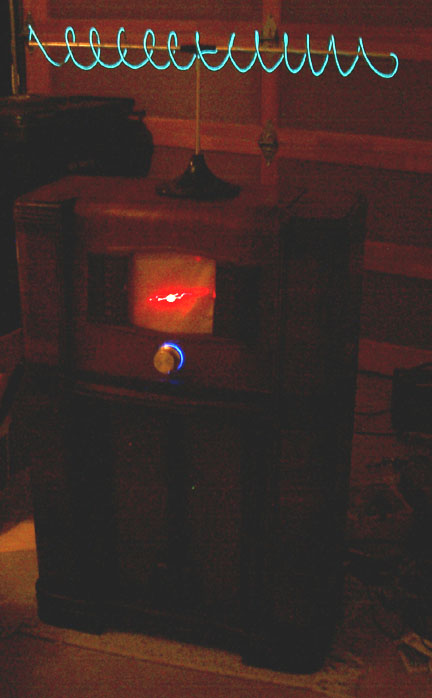
At night. The laser display and EL wire antenna come alive in the dark.
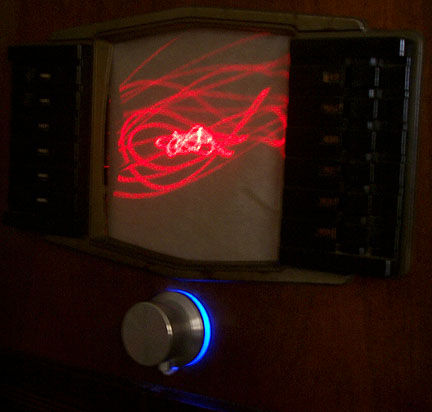
Radio dial closeup. A closeup of the radio dial laser display.
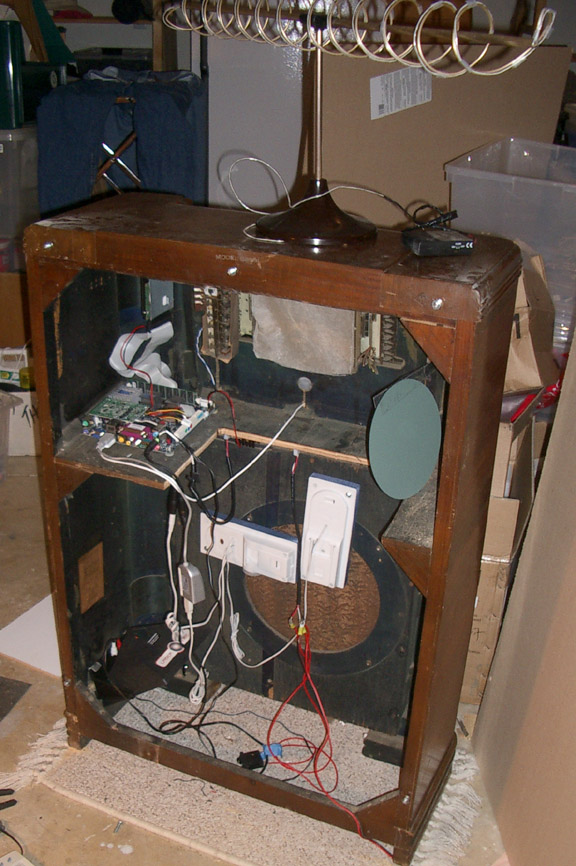
Inside view. The computer and disk in the upper-left corner, laser in the lower-left corner, speakers in the middle, and the circular mirror in the upper-right corner.